| 7,000+ Reviews
 Free EU Shipping above 100€*
 400,000+ Customers Worldwide
 Worldwide Tracked Shipping


Why train with resistance bands?
Looking for an effective, portable and affordable way to build strength? The resistance band ticks every box. Unlike free weights, the band applies progressive tension: the more you stretch it, the greater the support. Your muscles work through the full range of motion, which maximises muscle recruitment and removes dead spots.
The other big advantage is versatility. With a single accessory, you can reproduce almost every classic strength training movement, from the upper body down to the legs. It's also a key tool for calisthenics and street workout athletes, who use it to assist their pull ups or their dips.
Finally, the band is gentle on your joints. Its smooth, jolt-free resistance reduces the risk of injury while keeping the work intense. Ideal for beginners, for rehab, or to complement heavier training.

Which muscles can you train with a resistance band?
The answer is simple: all of them. Resistance bands let you target every muscle group. For the upper body, you work the chest, back, shoulders, biceps and triceps. For the lower body, you activate the quads, hamstrings, glutes and calves. Not forgetting the core, which you can brace and strengthen through rotational movements.
This ability to train the entire body makes the band a perfect tool for a complete workout at home, with no need for a fully equipped gym.
12 band exercises anyone can do
Here's a selection of twelve complete moves to add to your routine. Every resistance band exercise below follows the same logic: explanation, step-by-step guide, benefits and muscles worked. Everything you need to train with confidence, at home or outdoors.
1. Squat with band over shoulder
The squat is the king of leg exercises. With a band placed above the shoulders, you add resistance that corrects your alignment and intensifies the work.
Steps:
- Place the band above your shoulders, feet shoulder-width apart.
- Lower down by bending your hips and knees, as if sitting back.
- Actively push your knees outwards against the resistance.
- Drive back up through your heels. Aim for 3 sets of 15 reps.
Benefits and muscles worked: this band exercise strengthens the quads and glutes, while activating the gluteus medius.

2. Glute bridge with band
An essential move to isolate the glutes, perfect for anyone wanting a toned, powerful lower body.
Steps:
- Lie on your back, band above the knees, feet flat on the floor.
- Lift your hips towards the ceiling, squeezing your glutes hard.
- Hold for a second at the top, knees pushed outwards.
- Lower slowly without fully resting your hips back down.
Benefits and muscles worked: you target the glutes and lower back. The lateral resistance also recruits the gluteus medius to stabilise your hips.
3. Monster walk: the lateral band step
This move from calisthenics is brilliant for activating the hips and improving stability, often used as a warm-up before squats.
Steps:
- Keep the band above your knees and bend your legs slightly.
- Take a step to the side while keeping constant tension.
- Bring the other foot in without letting the band go slack.
- Complete 15 steps in each direction.
Benefits and muscles worked: it strongly activates the gluteus medius and builds lateral hip stability, useful for all your leg movements.
4. Biceps curl with band
The go-to exercise for defined arms. The band delivers increasing tension that's ideal for the biceps.
Steps:
- Stand on the band with your feet, arms by your sides.
- Keep your elbows tucked into your torso.
- Bend your elbows to bring your hands up towards your shoulders.
- Control the lowering phase carefully.
Benefits and muscles worked: a focused workout for the biceps brachii, with peak tension at the top where the muscle is most contracted.

5. Standing hip abduction with band
A simple yet remarkably effective isolation exercise to strengthen an often-neglected area: the hip.
Steps:
- Place the band around your ankles.
- Stand on one leg, hands on your hips or on a support.
- Slowly raise the other leg out to the side against the resistance.
- Return under control. Do 12 reps per leg.
Benefits and muscles worked: it isolates the gluteus medius and strengthens the hip, improving your stability and helping prevent lower-back pain.
6. Push-ups with band across the back
A street workout classic to build pressing strength. The band adds resistance exactly where the push-up gets easy.
Steps:
- Run the band across your back and pin each end under your palms.
- Get into a push-up position, body braced and aligned.
- Lower your chest towards the floor under control.
- Press back up: tension increases at the top of the movement.
Benefits and muscles worked: this band exercise intensifies the work on the chest, triceps and shoulders, while bracing your core.

7. Bent-over row with band
The horizontal pull is essential for a wide back and good posture. The band makes it accessible anywhere.
Steps:
- Stand on the band with your feet and hinge your torso forward to 45°.
- Keep your back straight and your knees slightly bent.
- Pull your elbows back, squeezing your shoulder blades together.
- Lower slowly while keeping the tension.
Benefits and muscles worked: this band training move targets the lats, traps and rhomboids, key muscles for correcting a rounded posture.
8. Overhead band pulldown
This move mimics the pull-up and is excellent preparation for anyone wanting to master that flagship calisthenics skill.
Steps:
- Anchor the band to a high point, such as a pull-up bar or a door anchor.
- Grab it with arms extended overhead.
- Pull down towards your chest, squeezing your shoulder blades.
- Return slowly while controlling the resistance.
Benefits and muscles worked: it strengthens the lats and biceps, exactly the muscles you need to nail your first strict pull-ups.
9. Shoulder press with band
For wide, strong shoulders, the overhead press remains a sure bet, easily reproduced with a band.
Steps:
- Stand on the band, hands at shoulder height, palms facing forward.
- Brace your core to stabilise your back.
- Press up until your arms are extended overhead.
- Lower slowly back to the starting position.
Benefits and muscles worked: it targets the deltoids (front and side) and contributes to shoulder stability.

10. Lunges with band
Lunges build strength and balance one leg at a time. The band adds progressive load without any heavy equipment.
Steps:
- Loop the band under your front foot and hold the ends at shoulder height.
- Step the other leg back and lower until your rear knee nearly touches the floor.
- Keep your torso upright and your front knee aligned with your ankle.
- Push back up through your front heel. Alternate legs.
Benefits and muscles worked: a complete workout for the quads, glutes and hamstrings, with real gains in balance and coordination.
11. Triceps extension with band
The triceps make up two-thirds of your arm's volume. This at-home band exercise isolates them perfectly.
Steps:
- Hold the band behind your head, one hand fixed low against your back.
- The other hand grips the top of the band, elbow pointing to the ceiling.
- Extend your arm upwards while keeping the elbow still.
- Return slowly. Switch arms at the end of the set.
Benefits and muscles worked: it isolates the triceps brachii, a key muscle for building volume and pressing power.
12. Pull-up with band
To finish, the flagship move of street workout. The band assists you on the way up and helps you progress towards your first strict pull-up.
Steps:
- Attach the band to your pull-up bar and place one foot (or knee) in the bottom loop.
- Grip the bar with an overhand grip, hands shoulder-width apart.
- Pull yourself up until your chin clears the bar, squeezing your shoulder blades.
- Lower slowly, arms nearly extended, without dropping down.
Benefits and muscles worked: it targets the lats, biceps and traps. The band's assistance reduces the load to help you string reps together and build the strength needed for unassisted pull-ups.

How to perform your band exercises correctly
Beyond the list itself, execution quality makes all the difference. Here are the key points to master so every band workout is genuinely effective.
How to choose the right resistance band?
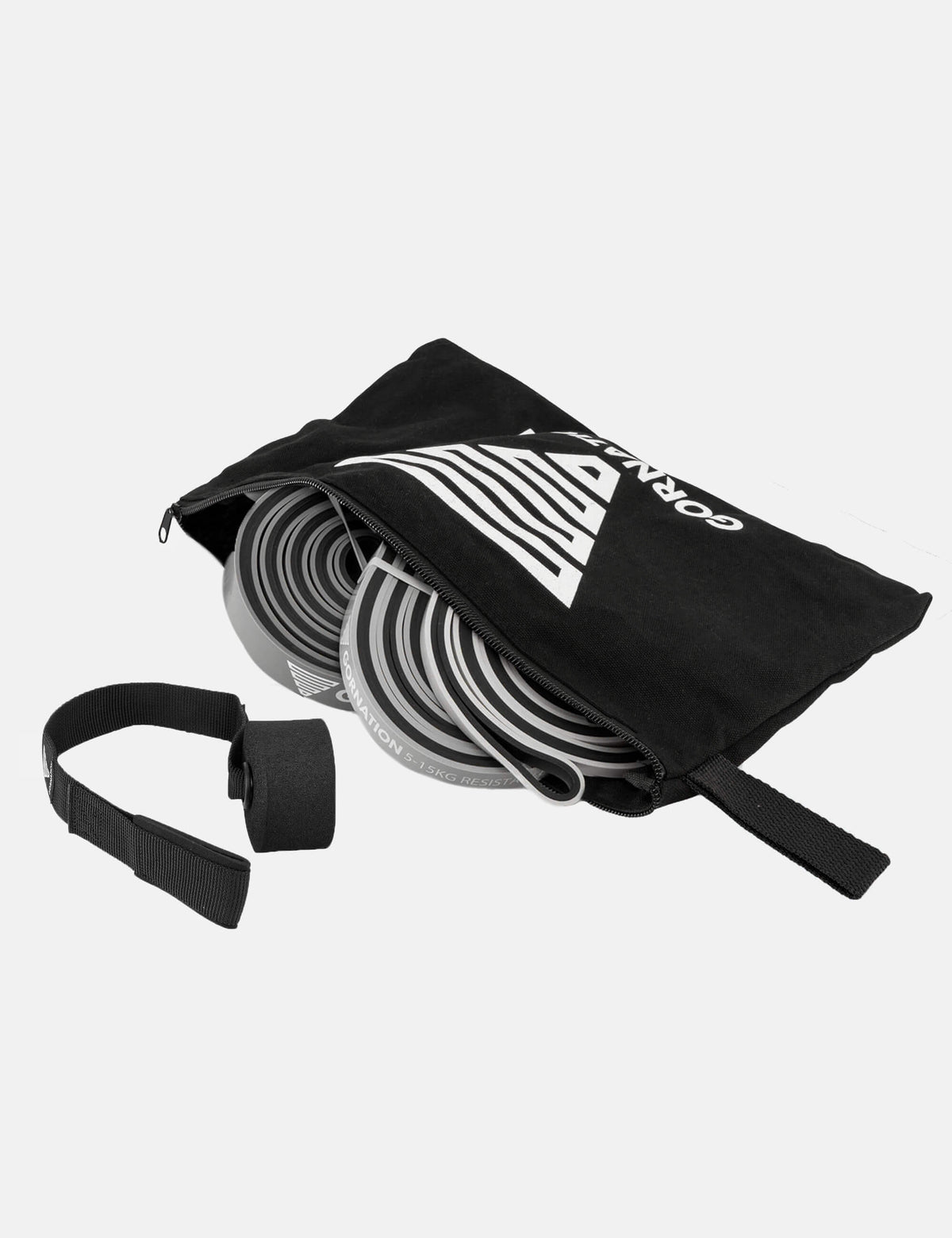
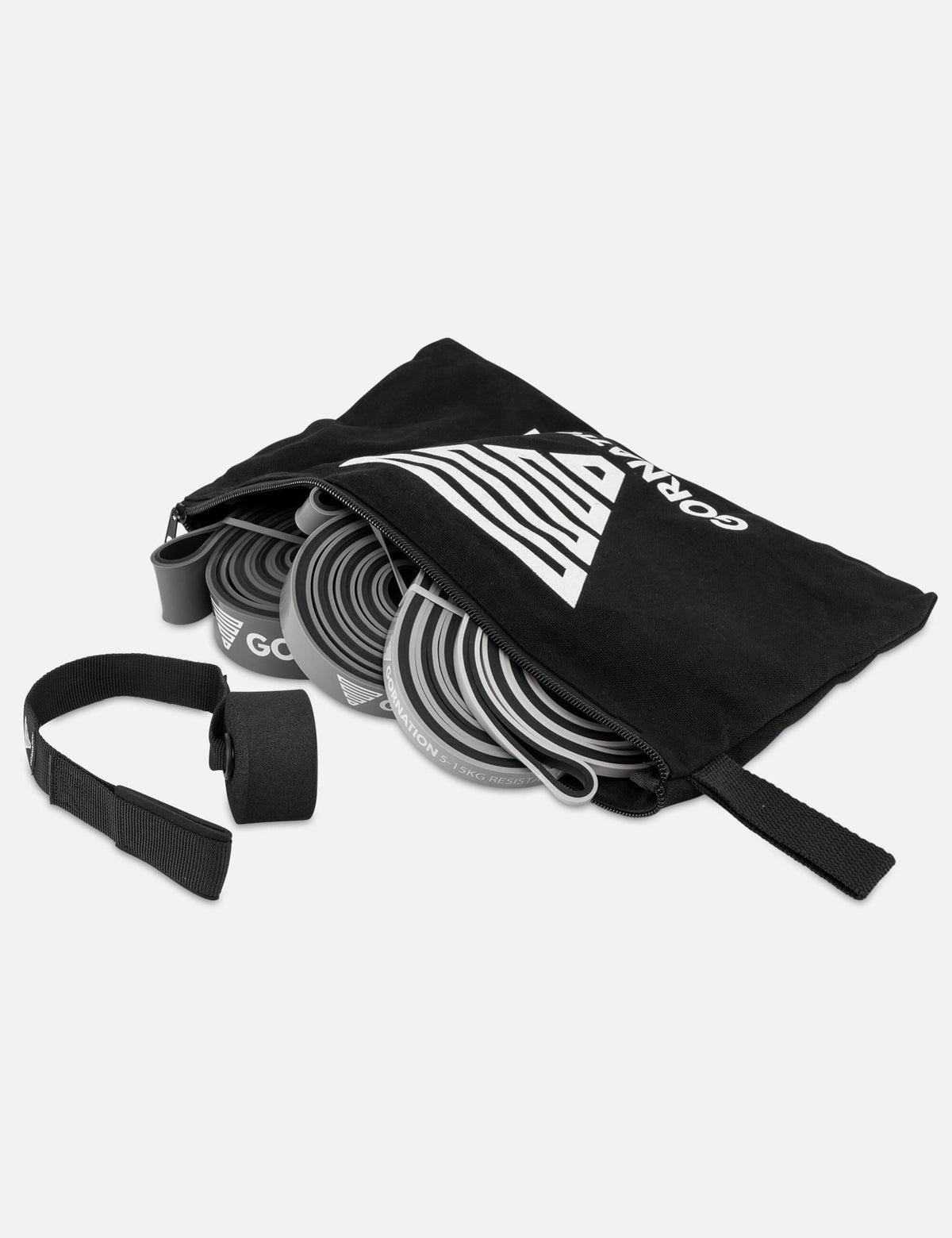
At GORNATION, the Premium resistance bands are graded by resistance level, made from skin-friendly natural latex: Ultra Light (2-7 kg), Light (5-15 kg), Medium (10-30 kg) and Heavy (20-40 kg).
The ultra-light band suits mobility work, warm-ups and smaller muscles like the biceps or shoulders. The medium and heavy versions are perfect for squats, pulls or assisting pull-ups and muscle ups. The right benchmark: you should be able to complete your reps with constant tension, without breaking your technique on the final ones. To cover all your needs, a set of 3 or 4 bands remains the most complete option, especially as it includes a door anchor to turn any door into a training station.
Mistakes to avoid with a resistance band
The first mistake is going too fast. The eccentric phase (the return) matters just as much as the push: always brake to keep the tension. The second pitfall is neglecting the band's anchor point. Always check that your attachment is secure so it can't slip free.
Finally, never let the band go completely slack between two reps. It's precisely the continuous tension that gives this tool its value. Keep it from the start to the end of every set.
What results can you expect from band training?
With regular training, you can gain strength, muscular endurance and tone. Resistance bands are especially effective for building muscle density and improving motor control. Combined with good nutrition, they also support fat loss thanks to dynamic sessions.
They also protect your joints thanks to their elasticity, which makes them an excellent complement to a calisthenics or traditional strength-training programme, as well as a complete solution for anyone training at home.
How many sessions per week to make progress?
For a beginner, 3 sessions a week of 30 to 45 minutes are enough to trigger real progress. The key is to give your muscles time to recover between two workouts targeting the same muscle group.
If you're more advanced, you can step up to 4 or 5 sessions, alternating upper and lower body. The band allows a high training frequency, as it stresses the joints less than heavy loads.
How to build your band training programme?
Structure your week by alternating body areas. An upper-body session with push-ups, rows, shoulder presses, curls and assisted pull-ups; a lower-body session with squats, lunges, glute bridges and abductions; and a full-body session combining both.
For each resistance band exercise, aim for 3 to 4 sets of 12 to 20 reps, always keeping good technique. Increase the difficulty by moving to a stronger band or by slowing down the tempo. This progression is the key to turning these simple movements into a genuine engine for muscle development, whether you're a street workout fan or simply after an effective home workout.